
The engineer completes the inspection. The repair areas are identified. The contractors submit their prices. The budget is approved.
Then the concrete is opened, and the damage is larger than expected.
What happens next?
This is one of the most important realities to understand before beginning a concrete restoration project.
What you see is not always the full repair
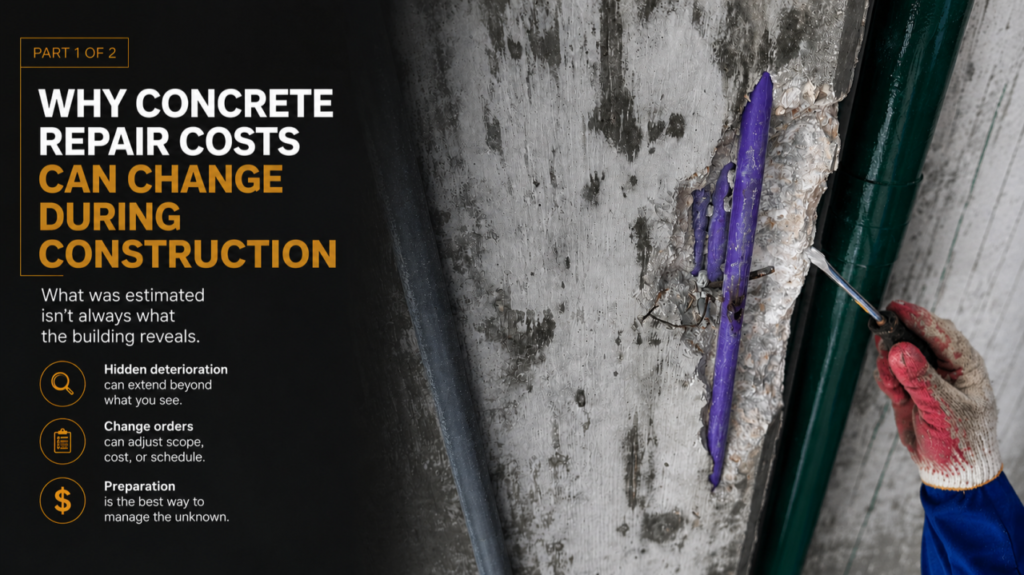
Concrete deterioration does not always stop where the visible damage stops.
An engineer may identify cracking, spalling or delamination during an inspection and use that information to estimate the amount of repair required.
But some conditions remain hidden.
Once deteriorated concrete is removed, the reinforcing steel becomes visible and the actual extent of the damage can be evaluated more completely.
And when the amount of work changes, the project may require what the construction industry calls a change order.
What is a change order?
Definition
A change order is a formal modification to the original construction contract. It records a change to the work that was originally agreed upon and can affect the scope, cost, schedule, or all three.
Consider a simplified example. An engineer estimates 4,000 sq. ft. of concrete repair, and contractors prepare their bids using that estimated quantity. Demolition begins, and the actual repair quantity becomes 5,600 sq. ft.
Engineer’s estimate
4,000 sq. ft.
After demolition
5,600 sq. ft.
Still to repair
+1,600 sq. ft.
The contractor may therefore submit a change order for the additional work.
So, was the original estimate wrong?
Not necessarily.
This is where concrete restoration becomes very different from buying a finished product with a fixed price.
The building itself is still revealing information during construction.
Inspections, testing and previous repair records can reduce uncertainty before work begins. But they cannot always eliminate it.
The project may move through a sequence like this:
The change in cost happens near the end of that sequence.
The uncertainty may have existed from the beginning.
The better question
When additional deterioration is discovered, the immediate reaction is often to ask who made the mistake. Sometimes that is a valid question. But there is another question that should come first.
The first reaction
Who made the mistake?
The better question
Could this condition reasonably have been identified before construction?
If the answer is yes, better investigation may have reduced the surprise.
If the answer is no, then the project was dealing with a genuine unknown.
Understanding that difference matters because concrete restoration will always contain some uncertainty.
The objective is not to predict everything hidden inside a building. It is to understand:
What do we know?
What are we estimating?
What could change once the concrete is opened?
Even when uncertainty cannot be eliminated,
its financial impact can often be anticipated.
Read Part 2
Worried about surprises once the concrete is opened?
Group Landev works with engineers and condominium associations throughout South Florida to identify where uncertainty sits before construction begins.
Talk to our teamThis article was originally published on LinkedIn.