
Part 2Start with Part 1: Why Concrete Repair Costs Can Change During Construction
In Part 1, we explained why concrete repair costs can change once construction begins.
Some deterioration is visible during inspection.
Some can be identified through testing.
And some conditions only become clear once the concrete is opened.
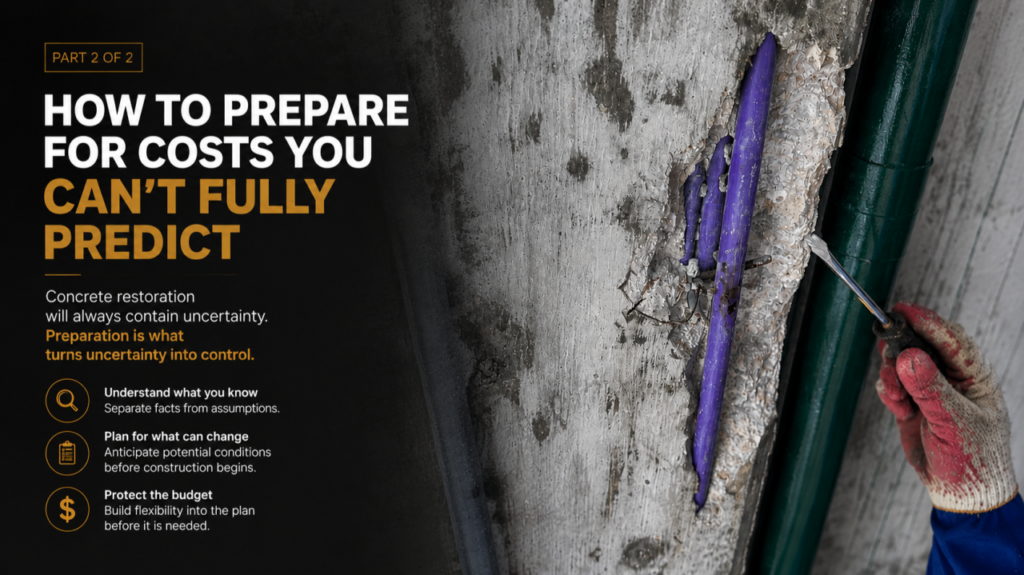
So how do you prepare a project for costs you cannot fully predict?
The answer is not to eliminate every unknown.
It is to plan for uncertainty before it becomes an unexpected expense.
Start with what you know
Before construction begins, separate what has been confirmed from what has been estimated. For example:
Known
Visible deterioration has been identified in specific areas.
Estimated
Approximately 4,000 sq. ft. of concrete may require repair.
Unknown
How far the deterioration extends behind the visible surface.
That distinction is important.
An estimate is necessary for planning and bidding, but it should not automatically be treated as a final quantity.
Use investigation to reduce uncertainty
The more information available before construction, the better the project can be planned.
Depending on the structure and the conditions observed, engineers may use:
These tools cannot reveal everything.
But they can help reduce the gap between what is estimated and what is actually found.
Plan for quantities that may change
Imagine a project is estimated to require 4,000 sq. ft. of concrete repair. Once demolition begins, the actual quantity becomes 5,600 sq. ft.
Estimated
4,000 sq. ft.
Actual
5,600 sq. ft.
Additional work
+1,600 sq. ft.
This is where planning before construction becomes important.
If the contract already establishes unit prices for additional concrete repair, the owner has a clearer way to understand how the additional quantity will affect the project cost.
Instead of asking what an unexpected repair might cost after it is discovered, part of that conversation has already happened.
Build flexibility into the budget
Some uncertainty can also be addressed through allowances and contingency.
They are not predictions that something will go wrong.
They are tools for acknowledging that the information available before construction may not be complete.
Make assumptions visible
A good construction proposal should help the owner understand more than the total price. It should make clear:
A good proposal answers
The clearer those answers are before construction begins, the easier it becomes to evaluate a change if one occurs.
The goal is not a project with zero change orders
A change order, as we explained in Part 1, is a formal modification to the original construction contract when the scope, cost, schedule, or other agreed conditions change.
Not every change order represents poor planning.
In concrete restoration, some conditions genuinely cannot be confirmed until work begins.
The objective is therefore not to promise that nothing will change.
The objective is to make sure the project is prepared if something does.
Better investigation
can reduce uncertainty.
Quantities & unit prices
can help price it.
Allowances & contingency
can help prepare the budget.
Clear assumptions
show where the uncertainty exists.
You may not know exactly what will be found when the concrete is opened.
But you can decide how prepared the project will be when it happens.
Planning a restoration budget?
Group Landev helps condominium associations throughout South Florida structure proposals with clear quantities, unit prices and assumptions before construction begins.
Talk to our teamThis article was originally published on LinkedIn.