
A concrete surface can look perfectly normal and still leave important questions unanswered.
Where is the reinforcing steel?
How much concrete cover is protecting it?
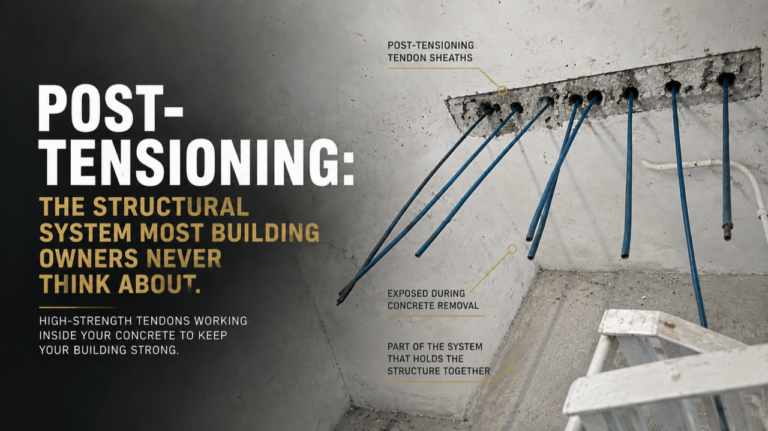
Are there conduits or post-tensioning components below the surface?
Are there voids, moisture-related anomalies, or other conditions that deserve a closer look?
The challenge with reinforced concrete is simple: some of the most important information is hidden from view.
That is why a proper structural investigation doesn’t necessarily stop at what can be seen from the surface.
Looking inside concrete without opening it
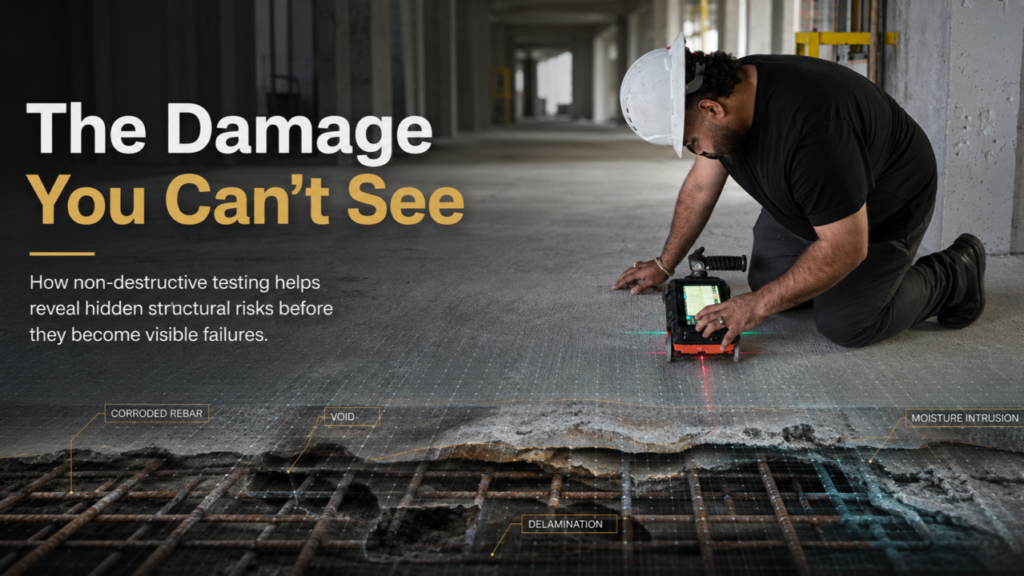
The equipment shown here is being used for nondestructive evaluation of concrete.
Ground-penetrating radar, or GPR, sends electromagnetic pulses into the concrete and records the signals reflected back by materials and interfaces below the surface.
As the scanner moves across the slab, those reflections allow a trained operator to build a picture of what is happening beneath the surface.
What GPR can help identify and map
Results depend on the structure, conditions and investigation.
And it can do this without unnecessarily cutting, drilling or coring into the concrete.
Why this matters
Visual inspections are extremely important.
Cracking, spalling, staining, exposed reinforcement and other visible conditions can tell an experienced inspector a great deal about a structure.
But concrete doesn’t always deteriorate from the outside in.
Water and chlorides can penetrate concrete and affect embedded reinforcing steel. Voids and construction defects can exist below an apparently sound surface. Reinforcement may not be exactly where drawings suggest it should be.
By the time some problems become obvious at the surface, the underlying condition may have been developing for years.
That is why what we can see is only one layer of the investigation.
The instrument doesn’t replace expertise
This distinction matters.
A GPR scanner isn’t an X-ray machine that simply produces a photograph of everything hidden inside a slab.
It produces data.
Reflections must be interpreted. Patterns must be understood. Measurements have limitations. Findings have to be considered alongside the structure’s drawings, history, environment, visible conditions and, when appropriate, results from other testing methods.
GPR may answer one question and reveal that another testing method is needed.
The value isn’t simply in owning sophisticated equipment.
Know
what question to ask
Choose
which tool can answer it
Interpret
what the data means for the structure
The value is knowing what question to ask, which tool can answer it, and what the resulting data actually means for the structure.
From visible symptoms to evidence
This becomes particularly important when evaluating existing buildings.
A crack isn’t a diagnosis.
A stain isn’t a diagnosis.
Spalled concrete isn’t a diagnosis.
They are evidence of something happening within a larger structural system.
A thorough investigation works backward from those observations and asks why they are occurring, how far the condition extends, what is happening beneath the surface, and what information is still missing.
Sometimes the answer is visible. Sometimes it requires another method of investigation:
The objective is the same: reduce uncertainty before making decisions about repair.
When you’re responsible for the condition of an existing structure, the most expensive problem isn’t necessarily the damage you can see.
It may be the damage you haven’t found yet.
Understand the condition before defining the repair.
At Group Landev, our approach to existing structures begins with understanding the condition before defining the repair. Better information leads to better scopes, better decisions and fewer surprises during construction.
Talk to our teamThis article was originally published on LinkedIn.